Why Top Founders Need Coaches

28.09.26 04:38 PM - By Erik Mueller

The Shift From Lone Operator to Chief Value Architect


The Myth of the Solitary Founder

In the early days of building a company, self-reliance is a superpower. You win deals through sheer willpower, solve operational fires personally, and keep the business moving forward through heroic effort.

But as your firm scales past $3M to $5M in revenue, the very trait that created your initial success—being the central hub of every decision—becomes the primary bottleneck capping your company's enterprise value.

Elite athletes don't hire coaches because they don't know how to play their sport; they hire coaches because you cannot see the picture when you are inside the frame.

In business, a great executive coach or fractional advisor does not give you generic motivation. They serve as a forensic mirror—exposing operational drag, questioning implicit assumptions, and holding you accountable to the long-term enterprise asset rather than the short-term operational fires.


The Three Blind Spots Every Founder Faces

1. Confusing Income with Transferable Value:
A highly profitable company that yields $2M in owner distribution seems healthy on the surface. But if client trust, lead generation, and key decisions still rely on the founder, institutional buyers see an enterprise asset with massive execution risk. A coach forces you to look beyond annual distributions and evaluate your business through the harsh lens of an M&A due diligence auditor.

2. The Operational Trap (The 3-Week Blackout Test):
Most founders believe their team is autonomous until they attempt to take a real 3-week vacation without checking Slack, email, or client emergencies. Without an outside perspective forcing structural decoupling, founders remain tethered to daily operations indefinitely.

3. The Accountability Gap:
As the CEO, you are the highest authority in your company. Your team rarely challenges your blind spots, and board meetings (if you have them) often focus on lagging financial results rather than leading operational indicators. A coach provides an unvarnished, peer-level sounding board where you can test strategy without political filter.


How Velocity Scaling Bridges Coaching with Hardened Operational Systems
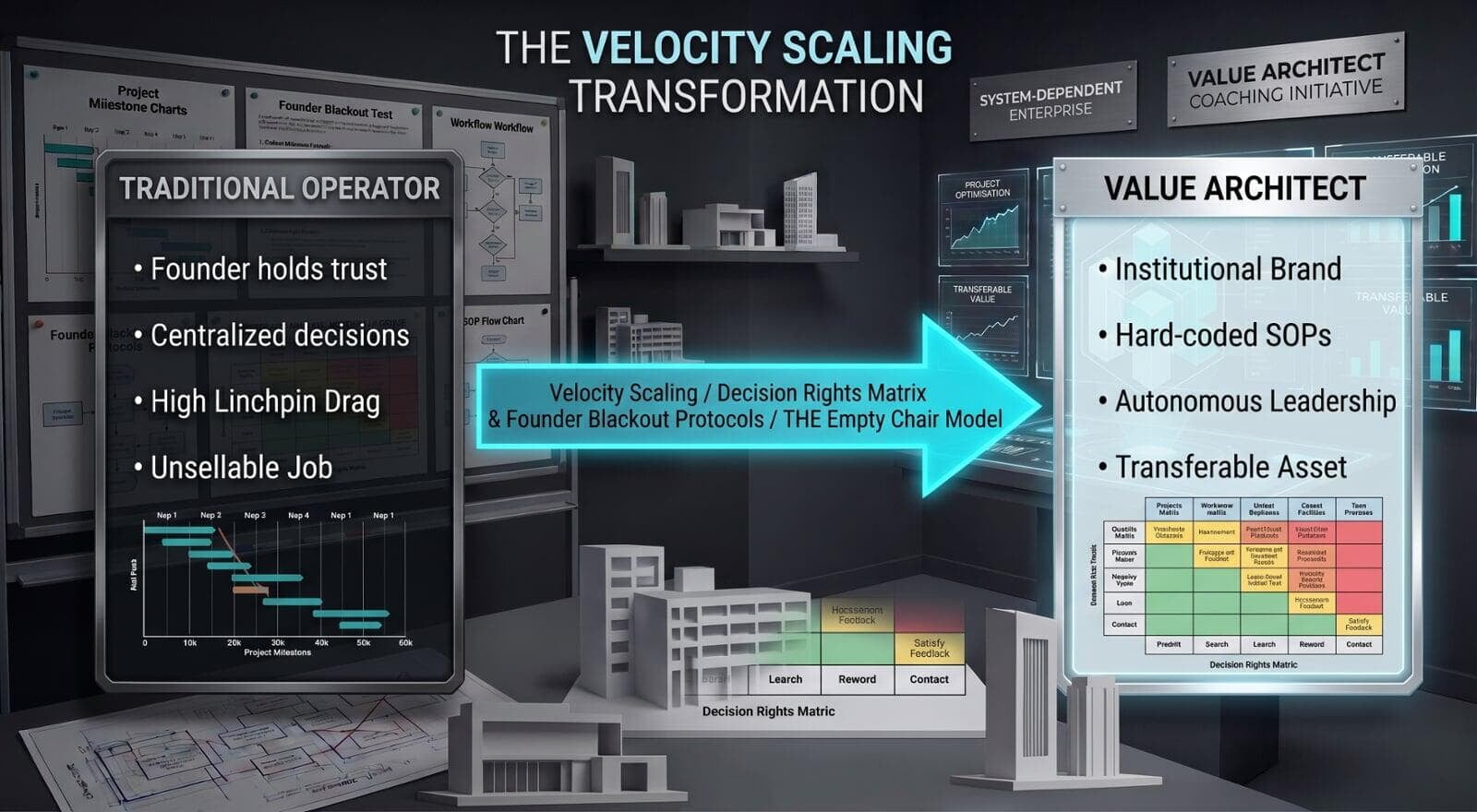
Traditional business coaching often falls into one of two traps: it stays at 30,000 feet with high-level mindset advice, or it hands you a generic framework without helping you build the underlying operational architecture.

At Velocity Scaling, we combine high-impact executive coaching with forensic operational engineering to turn founder-dependent businesses into self-sustaining enterprise assets.


Here is how our tailored advisory and coaching model accelerates your exit readiness:

  • Forensic Diagnostic Baseline: We begin by running your business through our 25-Factor Exit Readiness Audit, establishing your exact Enterprise Transferability Index and identifying your top 3 valuation drag factors before coaching begins.

  • The "Empty Chair" Governance Model: We don't just coach you to delegate; we help you map explicit Decision Rights and implement self-sustaining operating rhythms across your second-layer leadership team.

  • Strategy-to-Code Execution: We bridge executive coaching with technical execution—helping you hard-code accountability, KPIs, and SOP playbooks directly into your team's daily software stack.

  • Dual-Track Exit Readiness: We work with you on both the enterprise asset (maximizing your EBITDA multiple and removing key-person risk) and your personal readiness (calculating your exact Exit Magic Number and post-exit vision).


From High-Performing Operator to Chief Value Architect

Having a coach isn't a sign of weakness; it is the definitive strategy of founders who recognize that their time is their most scarce, non-renewable resource.


When you step out of daily tactical execution and embrace the role of Chief Value Architect, you accomplish two transformative goals: you buy back 20+ hours of personal time every single week, and you build a company that commands premium institutional valuation whenever you choose to exit.


Erik Mueller