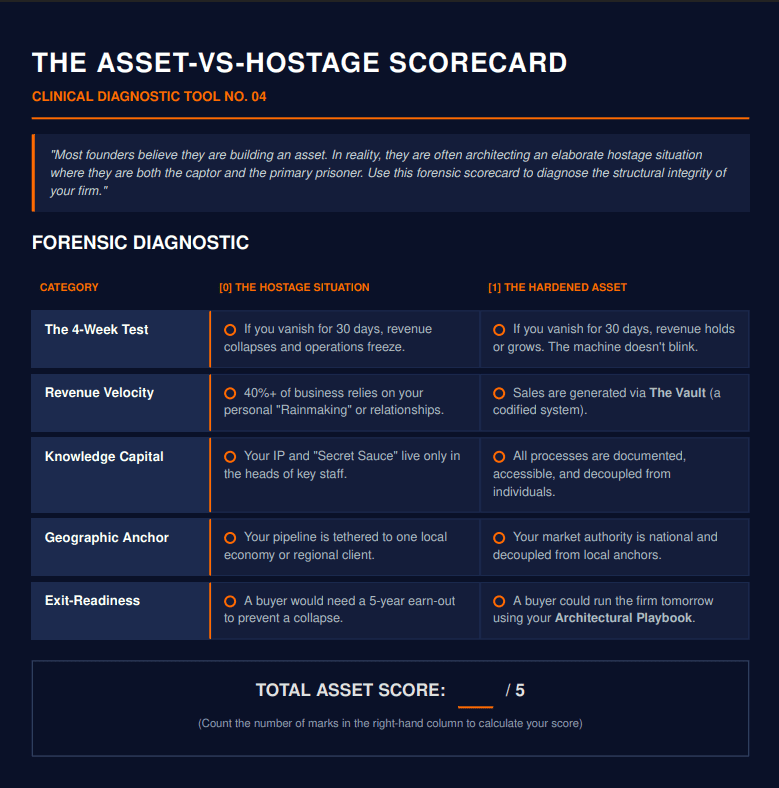
The Clinical Reality
Independent B2B firms operating within the $5M to $25M revenue liquidity band are currently witnessing a silent, systemic degradation of their customer acquisition machinery. The visible symptoms are highly predictable: inbound pipelines are drying up, customer acquisition costs (CAC) are rising, and sales cycles are stalling out for months on end.
The typical founder’s response to this operational bottleneck is to increase administrative pressure—demanding a higher volume of outbound cold outreach, louder marketing campaigns, and more intensive, high-touch pitching. This reaction treats the symptom while ignoring the structural cause. The forensic reality is that the traditional B2B pipeline is experiencing deep mechanical fatigue because the buyer demographic has radically shifted. Modern decision-makers have completely abandoned the linear, brand-controlled sales journey. When your firm continues to deploy an acquisition engine built on top-heavy, product-first pitches, it hits an invisible wall, forcing the founder back into the psychological prison of working 24/7 to personally salvage and close failing deals through sheer manual effort.
The Structural Flaw
This widespread failure is caused by an architectural misalignment: the reliance on a Linear Funnel Model in a non-linear market ecosystem. Traditional B2B marketing architectures are constructed on the assumption of a predictable sequence: Awareness, Consideration, and Conversion. This infrastructure relies on the vendor controlling information access, using gating mechanisms like "Request a Demo" or "Book a Discovery Call" to force engagement.
Modern B2B decision-makers do not operate within this controlled sequence. They orbit within a non-linear loop of self-guided discovery. They systematically cross-examine solutions across multi-platform networks, validate data through peer communities, and build an advanced understanding of your operational model long before they ever fill out an internal contact sheet. When an independent firm gatekeeps its technical context or relies on generic, polished marketing fluff, it creates immediate structural friction. The pipeline fractures because your outward systems attempt to force a sales pitch onto a buyer who is looking for a technical specification sheet.
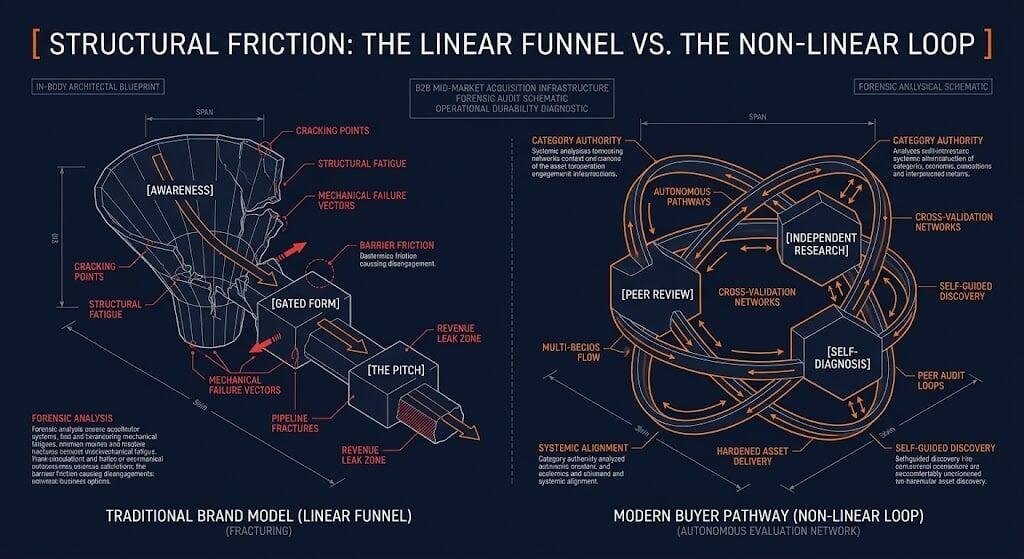
When your firm attempts to force an orbiting buyer down a linear track, you create immediate structural friction. You are trying to control an autonomous research pathway, which results in disengagement and pipeline failure.
The Architect’s Solution
Re-engineering this system requires a total reconstruction of your market activation layer, moving the firm away from promotional outreach toward an autonomous, un-gated educational infrastructure. You must replace the "Linchpin Liability" of high-touch founder selling with an institutional network of Hardened Assets that allow the buyer to self-diagnose on their own terms.
First, your public-facing messaging must shift from feature-focused product positioning to deep, clinical perspective. This requires building structural spans of un-gated knowledge assets—such as technical blueprints, methodology white papers, and objective logic engines—that teach rather than pitch. Instead of hiding your operational expertise behind a sales gate, you must deploy high-value, platform-native insights that help the prospect accurately quantify their own internal business friction. By integrating these self-guided discovery pathways into your GTM playbook, you align your company's acquisition mechanics with the natural evaluation loop of the modern B2B buying committee.