
The Disciplined Art of Enterprise Stewardship
The Toxic Misconception of the "For Sale" Sign
Mention the words EXIT PLANNING to a founder, and their immediate reflex is defensiveness:
"I’m not looking to retire."
"I love what I do."
"I don’t want to sell to private equity and watch them gut my culture."
This reaction comes from a fundamental misunderstanding of what exit planning actually is. Most business owners assume exit planning is an event-driven liquidation strategy—a hurried process you trigger when you are burned out, aging out, or ready to hand over the keys.
It is not.
Exit planning has very little to do with selling your business. At its core, exit planning is the highest form of fiduciary stewardship—of your time, your personal wealth, and the enterprise you have spent decades building from scratch.
The Stewardship Dividend: Building What Can Endure
When you strip away the M&A jargon, an exit-ready company is simply a well-run, resilient company.
It is an organization that does not require the heroics of a single person to open its doors on Monday morning. By architecting your company to operate independently of you, you protect the people who matter most:
- Your Employees: If your business cannot run without your direct oversight, your team's livelihood hangs by a thread. Systemizing the company guarantees stability and operational continuity for the people who trusted you with their careers.
- Your Family: Building a transferable asset protects your household against catastrophic life events—a sudden illness, personal burnout, or an unexpected passing—ensuring they inherit a self-sustaining asset rather than an unmanageable operational burden.
- Your Clients: When client trust is anchored to institutional systems, documented playbooks, and empowered leaders rather than a founder's personal cell phone, your service delivery remains predictable and resilient.
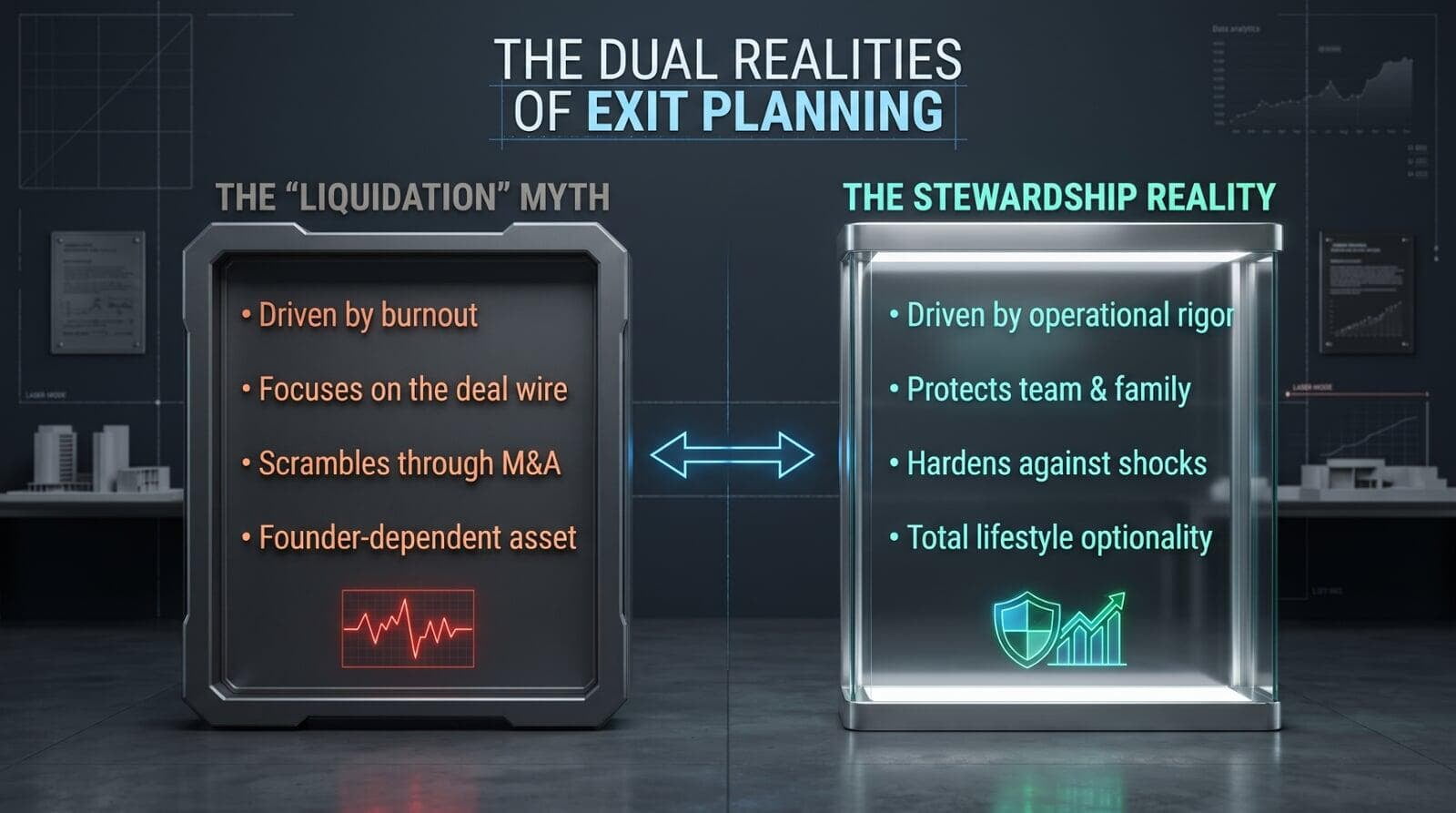
This is why I keep saying the goal is Exit Ready, Not For Sale.
A business that can run without you gives you something most sellers never get:
a choice. You can sell on your terms, on your timeline—or not at all. And either way, you've done the harder work: deciding who you are when the business isn't the answer anymore.
Stress-Testing for Reality: Surviving the Unforeseen
An owner-dependent business is fragile. A shift in macroeconomic headwinds, the departure of a key executive, or a founder medical emergency can wipe out years of equity in a matter of months.
Exit planning is operational insurance. It forces you to ask uncomfortable questions before the market asks them for you:
- If our top non-founder leader walks out tomorrow, does delivery stall?
- If credit markets tighten, does our gross margin structure hold up?
- If I take a 30-day medical leave, does the company grow, plateau, or bleed cash?
When you fix these vulnerabilities, you aren't preparing to pack your bags; you are building an antifragile machine that thrives in any environment.
Defense Against the Predator's Playbook
There is another, often unspoken reason to master this discipline: defending your life’s work against predatory buyers.
Unscrupulous buyers love founder-dependent, operationally loose companies. Their playbook is predictable:
- They issue an aggressive Letter of Intent (LOI) with an inflated headline multiple to flatter the founder's ego and tie the business up in 90 days of exclusivity.
- During Quality of Earnings (QofE) and due diligence, their forensic auditors aggressively pick apart your lack of documented SOPs, client concentration, and owner reliance.
- Two weeks before scheduled closing, they "re-trade" the deal—slashing the purchase price by 30% or shifting half the cash into a punitive earn-out because the operational risk is demonstrably high.
A business that has undergone rigorous exit planning cannot be exploited this way. You know your true baseline, your data room is clean, your governance is verified, and you can walk away from bad faith offers with complete confidence.
From Operator to Chief Value Architect
Exit planning does not mean leaving; it means choosing how you lead.
When you shift from working in the business as an overworked operator to working on the business as a Value Architect, you replace tactical chaos with strategic leverage. You buy back your time today, build a company that honors your legacy, and secure ultimate optionality for tomorrow.