
Is the One You Didn't Ask For
The Tuesday Email You Weren’t Expecting
It usually arrives on an ordinary Tuesday.
An email from a firm you've never heard of. A "strategic buyer" is acquiring companies in your space. They're impressed by what you've built. Would you be open to a brief conversation?
NAVIX has a name for this: a U.F.O.—an Unsolicited Flattering Offer.
Flattering is the operative word. That's what it's designed to be. And it's exactly why it is so dangerous.
Here's what that offer actually is:
- It is not a valuation: Nobody has seen your financials, your customer concentration, or how much of the business still runs through you.
- It is not proceeds: No one has modeled your taxes, your add-backs, or the working capital you'll be forced to leave behind.
It is a number-shaped invitation, built to start a transaction on the buyer's timeline, with the buyer's preparation, against your surprise.
Where the Transaction Actually Dies
Because here's the part nobody tells you at the first call: the offer isn't where deals die. Diligence is.
NAVIX's own case files include a $12M logistics sale that collapsed in diligence. Twelve million dollars, gone—not because the business was bad, but because what the buyer found didn't match what the owner assumed. That gap between assumed and found is where price cuts, punitive earnouts, and dead deals live.
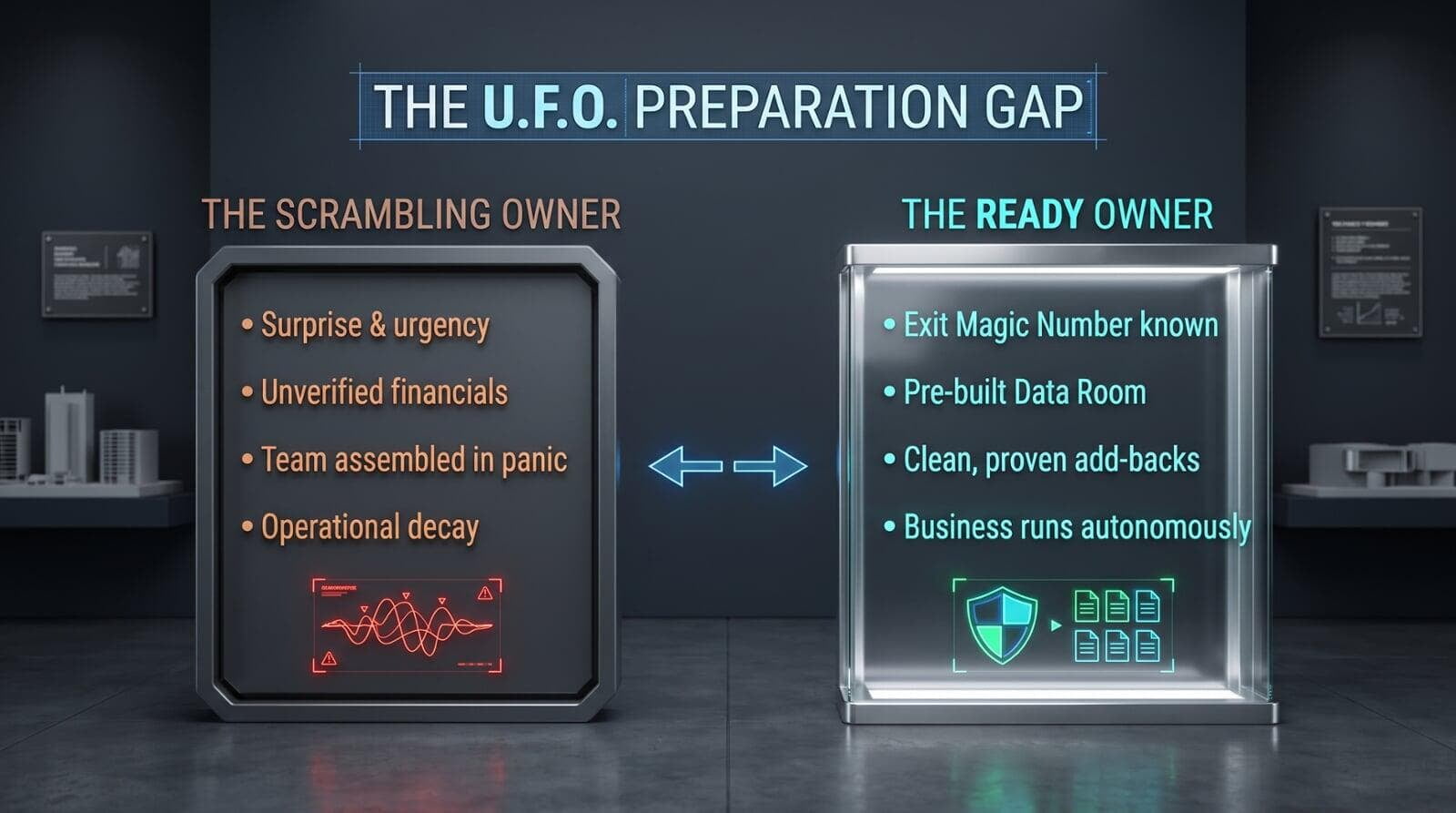
And while you scramble to close your gap, a second one opens. Diligence takes months. You spend them answering relentless document requests instead of running your company. Revenue softens. The buyer notices—they always notice—and reprices accordingly. Surprise doesn't just weaken your negotiating position. It compounds.
The Power of Being Option-Rich
Now run the same Tuesday with a ready owner.
The offer lands, and nothing spikes. He knows his Exit Magic Number™—what he actually needs, net after tax, not just what someone might pay. His financials are clean, with the add-backs already documented. The business has run without him, so the buyer can't discount the risk that he is the business. His team—accountant, M&A attorney, exit advisor—is already assembled, not speed-dialed in a panic.
Same offer. Completely different conversation. Because for him, the offer is an option, not a lifeline. He can say yes, negotiate hard, or say the most powerful word in any deal: no—and mean it, because he doesn't need the exit.
That's the whole doctrine in one scene. Exit Ready, Not For Sale. You don't get ready because you're selling. You get ready so that if the U.F.O. ever lands, it lands on your terms.
So here's the question I'd put to every founder who's ever gotten that email—or hopes to:
If the call came next Tuesday, would you be negotiating? Or scrambling?
Be your own buyer first. Run the diligence on yourself before a stranger does it for you—and charges you for what they find.